> For the complete documentation index, see [llms.txt](https://docs.pullrequest.com/on-premise-server/llms.txt). Markdown versions of documentation pages are available by appending `.md` to page URLs; this page is available as [Markdown](https://docs.pullrequest.com/on-premise-server/upgrading-the-pullrequest-proxy.md).
# Upgrading PullRequest Proxy
There are two ways to upgrade HackerOne PullRequest Proxy
1. **RECOMMENDED** Configure the PullRequest Proxy installation for auto-upgrade. These can be initiated from the HackerOne Code dashboard.
2. Manual installation. New versions are provided by HackerOne staff as a tarball package.
{% hint style="info" %}
**HackerOne recommends configuring for auto-upgrade so new service features, optimizations are i**mmediately available.
{% endhint %}
### Manual Upgrade
To manually upgrade, you'll first have to stop PullRequest Proxy service from running:
```
systemctl stop pullrequest-proxy
```
Now, go ahead and switch to the `pullrequest` user and install the new package over top of the old one:
```
su pullrequest
cd $HOME
curl --output - | tar zxvf -
exit
```
Now, a simple `start` for the service should bring in the new version:
```
systemctl start pullrequest-proxy
```
### Auto-Upgrade
Auto-Upgrade is feature included in PullRequest Proxy. It uses the existing environment to manage multiple versions of the proxy software. As such, it's a convenient way for the PullRequest application to upgrade your proxy to the latest release automatically without having to schedule downtime to perform the manual upgrade.
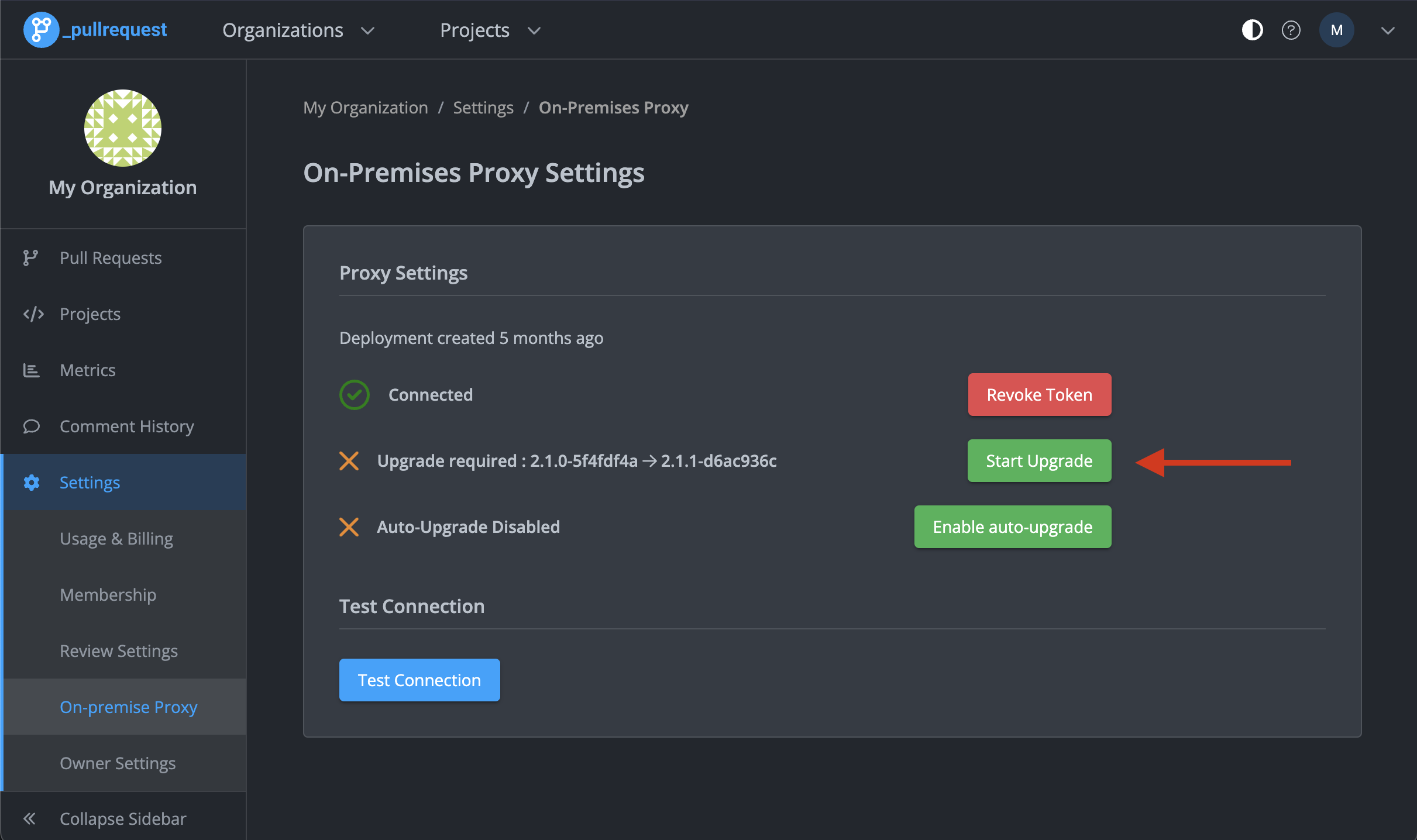
As this feature is enabled by default, most users won't have to perform any action to take advantage of it. However, if you do not want the proxy to upgrade automatically, you may turn this feature off from your organization's status page on :
If you decide to disable auto-upgrade, you will still be able to take advantage of its functionality when a new upgrade is available, but it will require you to push the "Start Upgrade" button.
Auto-upgrade is very quick and should have a minimal effect, if any, on your organization's workflow. As such, we recommend that it be enabled. In this way, we can automatically roll out bug fixes and new features to on-premise customers without needing to schedule a maintenance window.